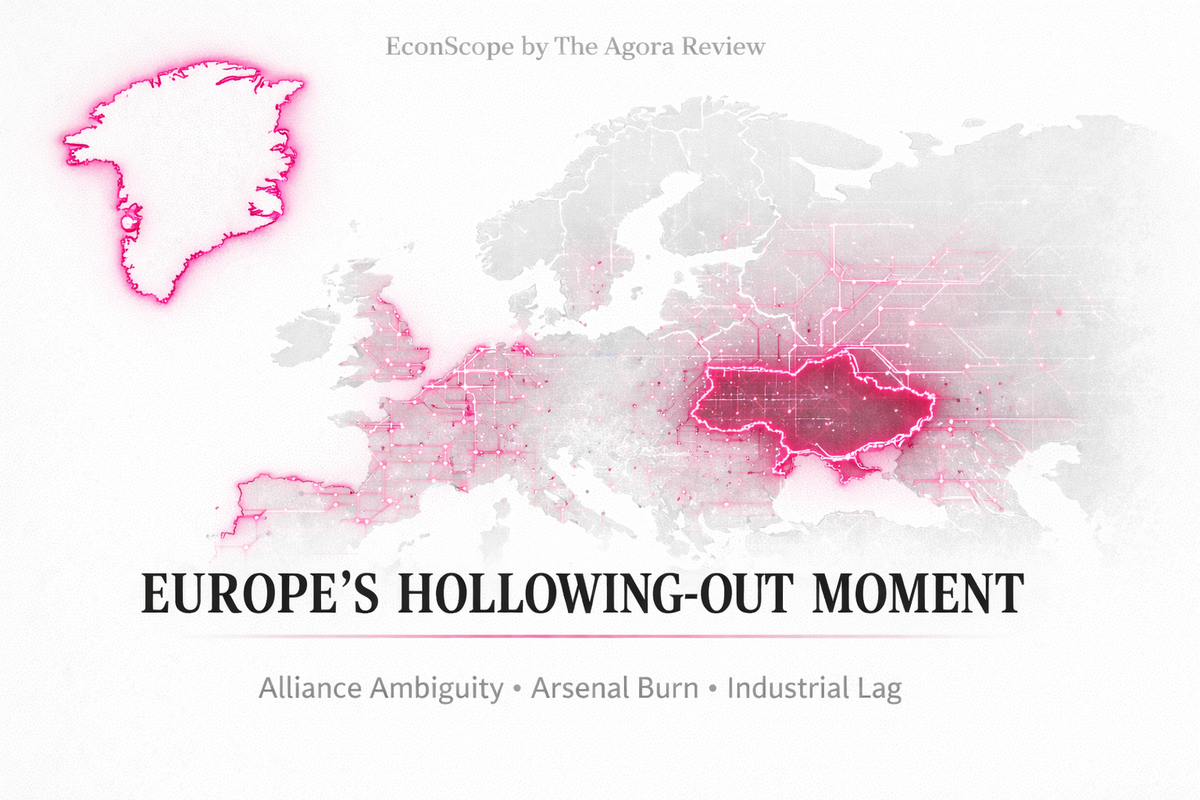
EUROPE’S HOLLOWING-OUT MOMENT

EUROPE’S HOLLOWING-OUT MOMENT
Europe is becoming geopolitically weaker because its military stockpiles are shrinking faster than they can be rebuilt via its industrial capacity, leaving it vulnerable even while alliances formally remain in place.
ΕWhen the Alliance Stays Intact —
But Reassurance Gets Repriced

Europe’s ‘hollowing-out’ moment is a throughput problem - not really a 'break-up'.

Click ΕΛ to show the Greek translation

Europe is learning a brutal, under-discussed lesson: reassurance now has a lead time.

Not because NATO is “ending,” and not because Washington has filed for divorce. But because what used to feel like an on-demand guarantee increasingly behaves like a supply chain: approvals, inventories, production capacity, and the network permissions that determine whether any of it moves fast enough.

January 2026 made that reality visible in one week.

First, the U.S. captured Venezuela’s leader and moved him toward U.S. jurisdiction, triggering immediate legal and legitimacy questions at the UN and beyond (Reuters on legal questions; Reuters on the UN chief’s concerns; Reuters on the UN rights office warning).

Days later, the White House said the U.S. military was “always an option” in the push to acquire Greenland—an autonomous territory inside the Kingdom of Denmark, a NATO member. Denmark’s prime minister warned a U.S. takeover would mark the end of NATO (AP; AP). European leaders rallied behind Greenland (Reuters), while reporting suggested institutional caution in Brussels (EUobserver).

And beneath both shocks sat the least theatrical constraint of all: Europe’s stockpiles and production tempo. NATO has publicly acknowledged that allied stocks were depleted early in the war and are “running quite low,” and that the alliance is now focused on ramping up production (NATO transcript, Feb. 17, 2024).

This is the core of the “hollowing-out” thesis. It isn’t collapse. It’s a vulnerability window: Europe is asked to carry more, sooner, while the material rebuild is still governed by industrial time and network friction. If Washington is willing to test legal and sovereignty boundaries in the hemisphere, Europeans have to price the possibility of boundary-testing inside the alliance system too.

To make the pattern legible—and to keep it from sounding like a mood—start with two models.

1️⃣
The theory that explains why this keeps happening

Offshore balancing: burden shifting without formally leaving the alliance

Offshore balancing is a realist grand-strategy idea: a dominant power tries to avoid being the default onshore enforcer everywhere. It encourages regional powers to carry more of the conventional load, while keeping the ability to intervene selectively if a true regional hegemon threatens to emerge (Foreign Affairs: Mearsheimer & Walt (2016); reference copy via Belfer).

In practice, offshore balancing rarely looks like a clean “withdrawal.” It looks like repriced reassurance: support becomes more procedural, more conditional, more episodic, and more entangled with allied performance (“through institutions,” “in tranches,” “after allies do X,” “subject to process”). The alliance remains; the feel changes.

Europe now carries more of the security burden on the ground

Why it matters for Europe: it explains how the near-term burden can shift even while the treaty architecture stays intact.

Weaponized interdependence: power through networks, chokepoints, and permissions

Where offshore balancing is about who carries the burden, weaponized interdependence is about how modern power is exercised without moving armies. Henry Farrell and Abraham Newman argue global economic networks aren’t flat; they have hubs and chokepoints. States positioned at key nodes can turn network centrality into coercive power—by restricting access and shaping the terms of participation (International Security (2019); Belfer reference page; Foreign Affairs (2025)).

Two effects matter directly for Europe’s industrial catch-up:

  • Chokepoint effects: denial or constraint through finance, payments, export controls, standards, platform rules, shipping/insurance compliance, licensing—in plain terms, “network permissions.”
  • Panopticon effects: informational advantage from controlling key nodes and monitoring flows.
Power increasingly comes from controlling access to networks

Why it matters for Europe: replenishment isn’t just funding and factories. It’s also inputs, standards, licensing, and cross-border procurement coordination—precisely where chokepoints slow what politics wants to accelerate.

Together, these models produce a predictable stress pattern.

2️⃣
The stress pattern: a system, not a headline

Put the two together and you get a cycle that can repeat without a formal rupture:

  • Alliance ambiguity (reassurance gets repriced): burden shifting doesn’t announce itself as abandonment. It shows up as conditionality, procedure, sequencing.
  • Arsenal burn (self-insurance is paid first in inventory): Europe covers the near term by drawing down stocks and accelerating transfers.
  • Industrial lag (replenishment is time-bound and permissions-bound): even when money is available, output is constrained by time-to-scale and by the chokepoints embedded in supply chains, standards, and licensing.

This is why “hollowing out” is the right frame. It captures something subtle but strategically dangerous: Europe can be doing the correct thing—forward defense through Ukraine support—and still become temporarily easier to pressure during the rebuild window.

3️⃣
January 2026: three signals, one geometry

Venezuela: the rules shock

The Venezuela operation became a legality-and-precedent debate—exactly the kind of case Europe cannot treat as “just another headline,” because Europe depends on rules stability almost as much as it depends on U.S. capability (Reuters; Reuters; Reuters).

The EU’s response was revealing in its restraint: a call for calm, restraint, and respect for international law and the UN Charter—supported by 26 member states (EEAS statement, Jan. 4, 2026; Euronews).

This was not Europe “defending Maduro.” It was Europe managing a structural collision: when the rules pillar shakes and the security provider is the actor, Europe defaults to procedural language because escalation risks spillover into the files Europe cannot afford to destabilize.

Greenland: the taboo shock inside the alliance

Greenland hit a different nerve. Alliances run on assumptions as much as on clauses—especially the assumption that internal borders are boring. Once allied territory is rhetorically negotiable, planners must hedge against contingencies that should never be on the table.

AP documented the White House line that force was “always an option,” and Denmark’s prime minister replied that a takeover would end NATO (AP; AP). European leaders rallied behind Greenland (Reuters).

The institutional balancing act was visible too: reporting noted the European Commission stopped short of full-throated condemnation, reiterating previously stated positions (EUobserver).

That is alliance ambiguity in practice: solidarity is signaled, but escalation is managed—because Europe still needs cooperation elsewhere, and because it cannot afford to turn intra-alliance stress into a self-inflicted fracture.

Ammunition: the arithmetic underneath the rhetoric

The third signal is the one that turns geopolitics into a timeline problem. The Ukraine war forced allies to spend down inventories to sustain Kyiv, and it exposed the gap between wartime consumption and peacetime production. NATO has stated plainly that allied stocks are “running quite low,” and that production ramp-up is now central (NATO transcript).

The EU’s shell pledge is the clearest public measure of Europe’s industrial time constant:

This is the hollowing-out mechanism in its simplest form: demand is immediate; replenishment is delayed; deterrence credibility is time-bound.

4️⃣
Europe’s Vulnerability Window

Europe is entering a reassurance lead-time problem. The alliance can remain intact while the time-to-deliver expands. Deterrence depends on what can arrive fast enough, at scale, with legal and industrial clearance already in place.

There is also a geographic hierarchy at work. In the U.S. near hemisphere, enforcement is quicker and more unilateral; elsewhere, reassurance increasingly runs through allies, process, and production lead times. If Washington leans toward offshore balancing, the alliance can remain intact while Europe is pushed to self-insure more, sooner, with fewer automatic cushions (Foreign Affairs).

At the same time, Europe’s ability to compensate depends on industrial scaling that is permissions-bound and chokepoint-prone—precisely what weaponized interdependence predicts (International Security; Foreign Affairs (2025)).

January 2026 compressed both logics into one moment. Venezuela stressed the rules pillar. Greenland stressed the alliance taboo pillar. Ammunition exposed the material pillar. The same European constraint set lit up every time: dependence plus lead time.

That’s what makes this episode more than a news cycle. It is a structural warning.

5️⃣
What a serious European response looks like in 2026

If the diagnosis is a vulnerability window, the response can’t be mostly rhetorical. It has to be measurable—designed to shrink the lead time of reassurance.

1) Publish the war-fighting balance sheet (inside the alliance)

Europe does needs credible planning: stockpile floors, replenishment schedules, and surge assumptions among key allies. If deterrence is inventory-backed, then inventories cannot remain a black box.

2) Convert industrial policy into deterrence policy

ASAP is directionally correct. The test is whether Europe can commit to multi-year demand signals that justify expansion, standardize procurement enough to aggregate orders, and remove cross-border bottlenecks that turn “European capacity” into national silos.

3) Treat chokepoints as strategic terrain

If permissions and dependencies shape output, Europe must map them like it mapped energy dependence after 2022: propellants, components, specialized machine tools, certification pathways, licensing delays, standards mismatches, and any single-point dependencies that can bottleneck surge production.

4) Make alliance territory boring again

The objective is not escalation. It is to reduce ambiguity inside NATO so planners stop hedging against scenarios that should never be in play. Greenland demonstrated how quickly rhetoric can become an institutional stress test (AP; AP; Reuters).

5) Build a “reassurance lead-time” dashboard

If Europe wants a single internal metric that matches the moment, it’s this: time-to-replace what has been transferred, time-to-surge under stress, and time-to-clear the permissions that slow both. In a world of repriced reassurance, credibility is measured in weeks and months—not in communiqués.

Closing

Europe’s hollowing-out moment is not the end of the alliance. It’s the end of a certain feeling: the assumption that reassurance is instantaneous, politically frictionless, and materially unconstrained.

Offshore balancing explains how the burden can shift without a breakup. Weaponized interdependence explains why catching up can be slower than writing a check. January 2026 forced Europe to confront both at once.

The real European question for the year ahead is not “Will NATO survive?” It is sharper, and harder:

Can Europe rebuild material depth fast enough that reassurance stops being a debate and becomes a fact?

So far, its issue seems like a throughput-and-permissions constraint created by allied burden shifting + industrial chokepoints, producing a vulnerability window even under alliance-friendly rhetoric.

Sources

·       Reuters — Was the U.S. capture of Venezuela’s president legal? (Jan. 3, 2026)

·       Reuters — UN chief raises concerns on legality/instability (Jan. 5, 2026)

·       Reuters — UN rights office: “world less safe” after U.S. action (Jan. 6, 2026)

·       AP — White House: military force “always an option” (Greenland)

·       AP — Frederiksen: U.S. takeover would mean “end of NATO”

·       Reuters — European leaders: only Greenland/Denmark decide their future (Jan. 6, 2026)

·       EUobserver — Commission caution on Greenland episode

·       NATO — Remarks: stock depletion and production ramp (Feb. 17, 2024)

·       Foreign Affairs — Mearsheimer & Walt: The Case for Offshore Balancing (2016)

·       Belfer — Reference copy: The Case for Offshore Balancing

·       International Security — Farrell & Newman: Weaponized Interdependence (2019)

·       Belfer — Weaponized Interdependence reference page

·       Foreign Affairs — Farrell & Newman: Weaponized World Economy (2025)

·       Reuters — EU will only supply about half the 1 million shells by March (Jan. 31, 2024)

·       Reuters — EU has supplied over 980,000 shells (Nov. 11, 2024)

·       European Commission — ASAP press release (IP/24/1495)

·       EEAS — High Representative statement on Venezuela (Jan. 4, 2026)

·       Euronews — EU calls for respect of international law (Jan. 4, 2026)

Subscribe to EconScope by The Agora Review

Don’t miss out on the latest issues. Sign up now to get access to the library of members-only issues.

jamie@example.com
Subscribe